
Let's talk about the timing problem no one addresses
Here's what happens in most partnerships: one person reaches arousal in five minutes. The other takes twenty. Neither is wrong. Both are frustrated. You speed up to keep pace, they slow down to wait, and suddenly foreplay becomes a negotiation instead of a pleasure.
Timing mismatch in intimacy is one of the most common friction points couples face, and it's rarely about desire. It's about physiology. Your nervous system, your arousal arc, your body's unique chemistry. A Lemon vibrator isn't a workaround for this problem. It's a direct solution.
Why foreplay timing actually matters
When arousal rhythms don't align, three things tend to happen. One person feels pressured to catch up, which kills their authentic response. The other feels like they're waiting around, which breeds resentment. And both people end up performing a version of pleasure that doesn't belong to them.
Research on couples' satisfaction shows that when one partner feels rushed through their arousal process, satisfaction scores drop significantly. Not because the sex itself is bad, but because both people are managing anxiety about timing instead of managing pleasure.
That's where lemon vibrators change the dynamic entirely. They're not a supplement to foreplay. They're a timing equalizer.
The foreplay timing mismatch: three common patterns
Pattern one: You need longer. Your partner's ready in ten minutes. You need thirty. You either rush your body or watch them wait, which feels awkward and makes you self-conscious. This one kills desire faster than almost anything else.
Pattern two: You're ready faster. Your partner takes time to warm up. You want to move forward. They feel like they're behind, so they push themselves artificially. Now both of you are stressed and the whole thing unravels.
Pattern three: You sync up early, then they slow down. You build momentum together, but then their attention flags or they lose focus. You're left hanging. This one stings because you almost had it.
Each pattern has a different solution, but they all share one principle: external stimulation removes the pressure to keep pace internally.
How clitoral vibrators handle timing friction
A Lemon vibrator does something simple but crucial. It gives your body a consistent signal independent of what's happening with your partner. That means you can warm up at your own speed while they warm up at theirs. The vibrator isn't replacing their touch. It's running parallel to it.
Here's how it works practically:
If you need longer to arousal, introduce the Lemon vibrator early, when your partner is doing other things. You're getting clitoral input that builds your arousal while they're focused on other forms of touch. By the time they're ready for internal stimulation or deeper connection, you're actually there. No rush, no waiting, no performance.
If your partner needs longer, the vibrator works differently. You use it on yourself while they're building to arousal. They get to take their time without feeling like they're holding you back. You're managing your own pleasure, so the pressure's off both sides.
The third pattern is the trickiest because it's about attention, not speed. A vibrator helps here too, but the solution is partly mechanical and partly conversational. We'll get to that.
Starting the conversation without making it weird
Okay, so you want to bring a lemon vibrator into shared foreplay but you're nervous about how it'll land. Let's separate two things: the tool and the conversation.
The conversation isn't "I'm not satisfied." It's "Our bodies have different warm-up times and I want to solve that together." That's not a complaint. That's problem-solving.
You could say something like: "I noticed I need more time to get fully aroused, and I think you sometimes feel like you're waiting. I found something that might help us both relax." Or: "I want us both to be fully into this without anyone feeling rushed. I've been thinking about how to make that easier."
The key is framing it as a tool for both of you, not a fix for one person's inadequacy. Because it isn't. It's a timing synchronizer.
The practical choreography: timing patterns you can steal
Let's say you need longer to arousal. Here's a simple sequence:
Your partner initiates with touch. After a few minutes, you introduce the Lemon vibrator to yourself. They keep doing what they're doing. Now you're getting dual input and you're building toward arousal on your timeline. They're not waiting. They're just doing foreplay at their own pace. When you signal you're ready, you're actually ready.
Or the reverse: your partner needs longer. You use the vibrator while they're still warming up. No pressure on them. They take as long as they need. When they're ready for more contact, you're still present and aroused.
For the third pattern (attention fading), the vibrator serves a different purpose. It keeps you engaged and responsive even if their hands move elsewhere. You're not dependent on their continuous touch to maintain arousal. This is wildly underrated for partners who get distracted.
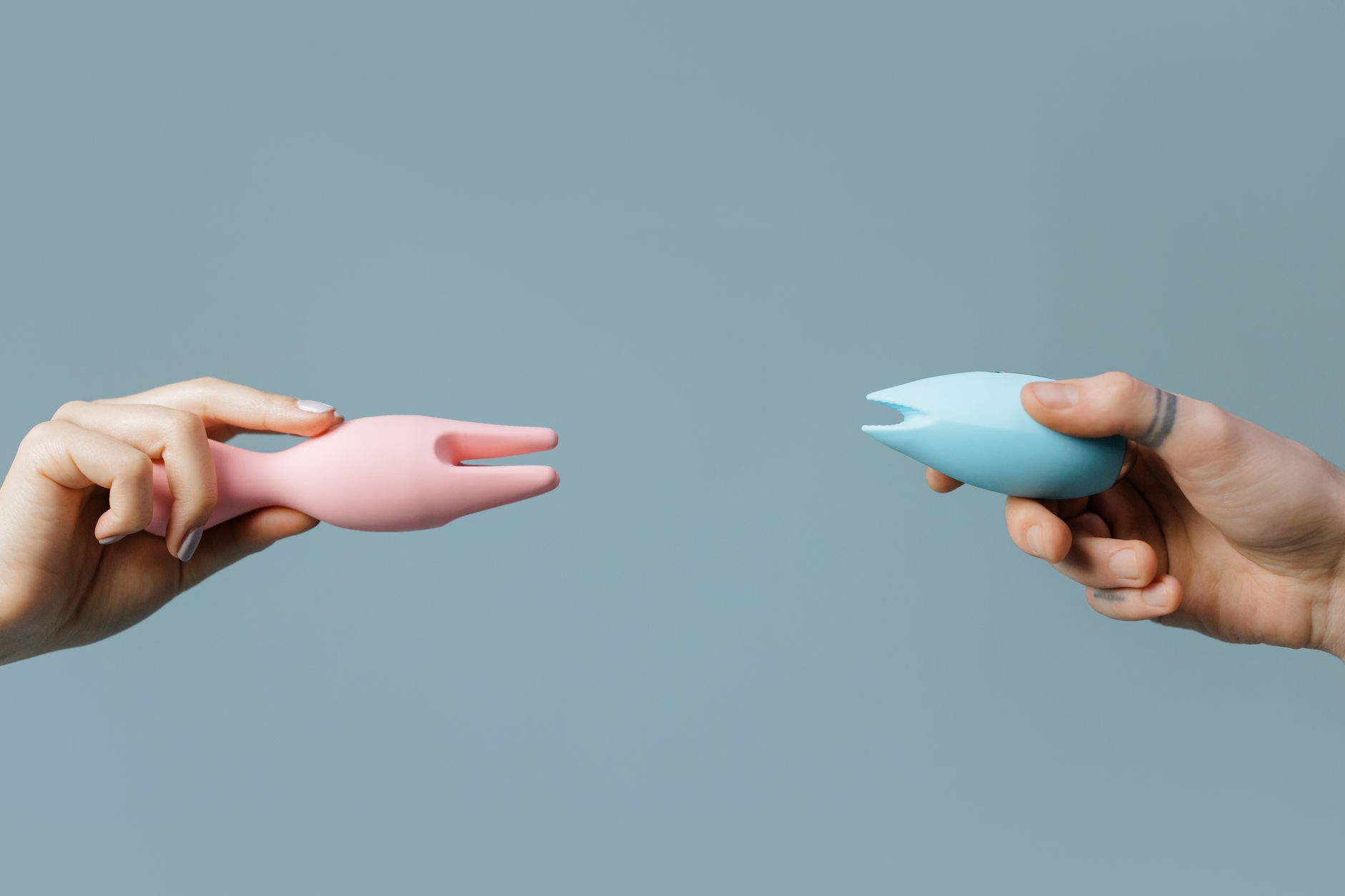
Photo by cottonbro studio on Pexels
Why suction-based stimulation works particularly well for couples
There's a reason clitoral suction devices like Lemon vibrators are especially useful in partnered scenarios. They provide consistent, broad-based stimulation that doesn't require precise rhythm or timing from your partner. You set the intensity. You control the contact.
This matters because it removes a layer of choreography. Your partner doesn't have to match your speed or pressure. They can focus on their own arousal, or on other forms of touch, while you're getting exactly what you need.
Lem vibrators also tend to be less jarring than traditional vibrators if you're someone who's sensitive to direct clitoral contact. The suction action is broader and less intense, which means you can stay with it longer without overstimulation. For timing issues, that's crucial. You want something sustainable, not something that peaks too fast.
Managing self-consciousness around toys
If you're worried your partner will feel replaced or left out, here's the honest part: good partners want you to feel good. Full stop. Using a vibrator isn't a referendum on their touch. It's a statement that you deserve consistent pleasure.
What sometimes helps: invite them in. Let them hold the vibrator. Let them apply it while they're doing other things. Suddenly it's not you and a toy. It's you, them, and a tool that serves both of you.
Or normalize it differently. Talk about foreplay as something that happens, not something your partner does to you. You're building pleasure together, and you each have tools for your own body. A Lemon vibrator is just one of yours.
When to call a deeper conversation
Here's something important: timing mismatches sometimes point to bigger stuff. If the real issue is that one of you has checked out, or you're avoiding vulnerability, or there's resentment underneath, a vibrator won't fix that.
But if the issue is genuinely physiological, and you're both willing partners, a Lemon vibrator can be genuinely transformative. It stops foreplay from becoming a performance and starts it being actual pleasure again.
Consider professional guidance if you notice the timing issue is getting worse, or if introducing a toy creates unexpected tension. Sometimes couples counseling helps clarify what's really underneath the friction.
Building the muscle memory of synchronized pleasure
The first time you use a vibrator as a timing tool, it might feel awkward. That's normal. Your brain is learning a new way of organizing pleasure. By the third or fourth time, it becomes natural.
What tends to happen is partners stop thinking about timing at all. You're both just in the experience. The vibrator is doing its job quietly, and you're both more present because neither of you is managing anxiety about pace.
Likewise, you might notice your natural arousal timing starts to shift once the pressure's off. When you're not trying to keep up, your body often responds faster. Paradoxically, removing the speed concern makes you quicker to arousal.
A final word on pleasure as a conversation
Using a Lemon vibrator when your foreplay timing is mismatched isn't a workaround. It's a conversation between your bodies and your partner's body. It says: I care about my pleasure. I also care about ours. These tools help us both have what we need.
That's not selfish. That's the foundation of partnered sex that actually feels good.
People also ask
Is using a vibrator during foreplay a sign that something's wrong in the relationship?
Not at all. Timing mismatches are physics, not feelings. A vibrator is a tool for managing that physics. Good couples use tools to support each other's pleasure. It's the same as lubricant or any other aid. It's practical, not pathological.
How do I bring up using a vibrator without my partner feeling inadequate?
Frame it as a timing solution, not a performance problem. Say something like: "Our bodies warm up on different timelines, and I want us both to feel good without anyone rushing." You're solving a logistics problem together, not critiquing anyone's skills.
Can I use a Lemon vibrator alone first before introducing it with a partner?
Yes, absolutely. Knowing how your body responds to it solo takes the pressure off when you introduce it partnered. You'll be more confident, and you'll know exactly what you like, which makes the conversation easier.
What if my partner is worried the vibrator will replace them?
Invite them in. Let them be part of it. Sometimes partners feel more connected when they're actually helping apply the vibrator, or when they see how much pleasure it brings you. It's not about replacing their touch. It's about adding a layer that benefits you both.
How long does it usually take to get comfortable using a toy with a partner?
Most couples feel natural about it by the third or fourth time. The first time is the awkward time. You're introducing something new, so there's slight discomfort. By experience two or three, it's just part of your rhythm.
What if our timing issues are about deeper incompatibility, not just arousal speed?
Timing tools help with pace. If the real issue is that you want different things, or there's resentment underneath, that's relationship work, not just a vibrator situation. Consider talking with a couples counselor if the friction feels bigger than logistics.