
Here's what erectile dysfunction actually changes
Let's be real. Erectile dysfunction (ED) arrives in a relationship like an unwelcome third party that immediately gets blamed for everything. One partner feels broken. The other feels rejected or inadequate. Sex becomes a performance test instead of an experience, and both people fail it together.
But here's the thing: ED doesn't end sex. It just ends the specific shape of sex you've been having.
And that's not a tragedy. That's an opportunity.
Why a clitoral vibrator changes the dynamic
When penetration becomes unpredictable or difficult, couples often freeze. They assume sex is off the table entirely. But vulva pleasure doesn't require an erect penis. Never has. Most people with vulvas don't orgasm from penetration alone anyway. We're talking about 20-30% at best.
A lemon vibrator like the Lem enters the picture and does something surprisingly radical: it removes the pressure from both partners. Your partner isn't responsible for your orgasm anymore. You're not responsible for maintaining their erection. You're both just focused on pleasure, together.
This sounds simple. It's wildly transformative.
I've worked with dozens of couples navigating ED, and the ones who recover the most intimacy aren't the ones who "fix" the ED first. They're the ones who stopped waiting to have good sex and started building it differently.
The conversation you need to have first
Before you bring a lemon clitoral vibrator into the bedroom, you need to separate two conversations that almost always get tangled.
Conversation one: "ED is happening and it's not about how I feel about you." This is the medical conversation. ED has a thousand causes. Most are fixable. Some aren't. But none of them are about desire or love. Get clear on that separately from the sex conversation.
Conversation two: "I want us to explore pleasure together differently." This is the intimacy conversation. It's not a consolation prize. It's not plan B. It's a genuine invitation to discover what actually feels good for both of you.
Do these separately. Do not combine them into "since you can't get it up, let's try a vibrator." That's a recipe for resentment. Instead: "I've been reading about ways couples can experience pleasure that don't depend on any single thing. Want to explore that together?"
The framing matters. A lot.
How to introduce the Lem without it feeling like a workaround
Three practical steps:
Start with curiosity, not crisis. Show your partner articles about clitoral vibrators. Talk about them the way you'd discuss anything else you're both learning about. The goal isn't to convince them it's necessary. It's to make it normal.
Let them hold it first, clothed. Seriously. Let them feel how light it is, how quiet, how nothing like what they might imagine. Demystification cuts anxiety in half.
Use it together, not instead. The first time you use a lemon clitoral vibrator with a partner, don't use it as a backup plan when ED shows up. Use it as part of foreplay while you're both aroused and present. This teaches your nervous system that pleasure with a vibrator is just pleasure. It's not a failure mode.
What changes when you make this shift
I've noticed four things happen consistently when couples move from "sex requires penetration" to "pleasure comes in many forms."
First: the pressure evaporates. When orgasm becomes independent from your partner's physical response, you both relax. Sex stops feeling like a test and starts feeling like connection. This alone often improves ED, because anxiety is one of the biggest drivers.
Second: foreplay actually gets foreplay time. Before, you were rushing toward penetration. Now you have permission to spend 20, 30, 45 minutes on touch, oral sex, and clitoral stimulation. Many partners report that this is the most connected sex they've had in years.
Third: you both actually finish. This is huge. If you've been faking orgasms or skipping them because you're waiting for penetration to work, you stop. Everyone gets pleasure. Everyone gets release. The asymmetry that's been building resentment for years dissolves.
Fourth: spontaneity comes back. When sex doesn't depend on specific physiological conditions, it becomes less precious and more frequent. You can have sex in the morning, in the evening, quickies, long sessions. ED no longer determines your sexual calendar.
Practical tips for using a lemon vibrator as a couple
Start low and communicate. The Lem has multiple intensity levels. Begin at level 1 or 2. If your partner is new to clitoral vibrators, this feels intense. Let the sensation build.
Use lubrication. Even if you don't think you need it, use it. Water-based lubrication reduces sensation drag and makes everything feel smoother. Your partner can apply it while you're being touched. It's intimate.
Take turns. One night, use the vibrator on your partner. The next time, they use it on you. This keeps the pleasure balanced and reminds you both that you're still actively participating in each other's pleasure.
Keep talking. "Does this feel good?" "Do you want more or less pressure?" "Do you like this pattern?" Communication during sex feels awkward at first. Then it becomes the hottest part because you're genuinely attuned to each other.
Don't make it the entire experience. Use the vibrator as part of sex, not instead of everything else. Touch, kissing, oral sex, hands, the vibrator. It's all part of the same experience.
When ED is tied to something deeper
Sometimes ED is purely physiological. Blood pressure meds, diabetes, cardiovascular issues, low testosterone. A urologist can help. Sometimes it's psychological. Anxiety, depression, stress. A therapist can help.
But sometimes ED is relational. You've been disconnected for years. Sex has felt transactional. There's resentment underneath that has nothing to do with erections.
A vibrator can't fix relational ED alone. But it can become a symbol that you're both willing to rebuild intimacy differently. It becomes the first domino. Everything else gets easier after that.
If you're not sure what's driving the ED in your relationship, talking to a couples therapist is worth it. Not because there's anything wrong with your relationship, but because ED is always a signal that something needs attention. Sometimes that's medicine. Sometimes it's conversation. Often it's both.
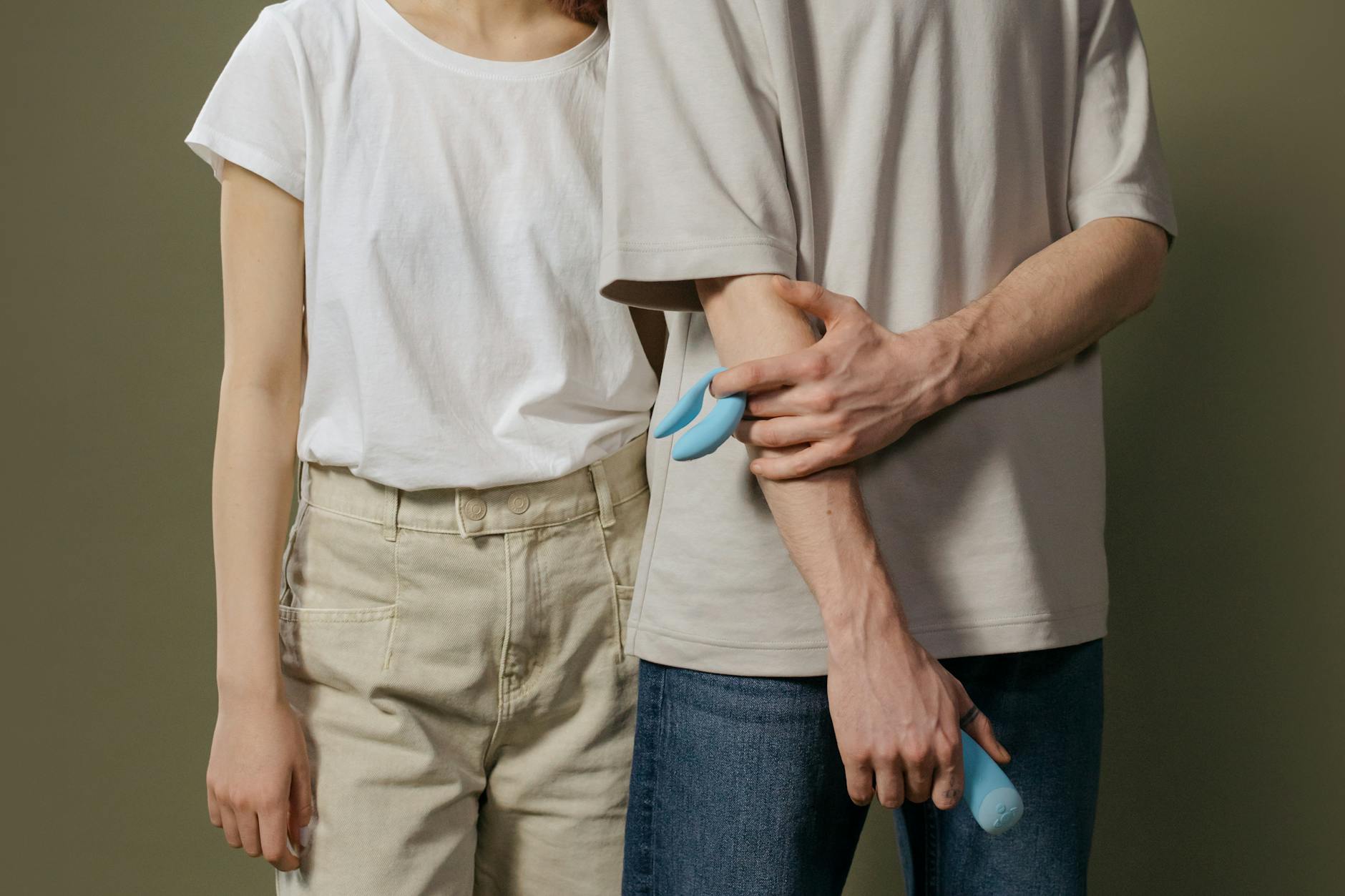
Photo by cottonbro studio on Pexels
The longer conversation about desire
Here's what I see happen over months when couples make this shift. Their entire understanding of sex changes.
They stop thinking about sex as a performance they're putting on for each other. They start thinking about it as something they're building together. They realize that pleasure is actually less about what your body can do and more about attention, presence, and willingness to explore.
Many couples tell me that this forced pivot because of ED actually deepened their intimacy more than years of "normal" sex ever did. Because suddenly you're communicating. You're asking what feels good instead of assuming. You're present instead of performing.
ED doesn't have to be the thing that kills sex in your relationship. It can be the thing that transforms it.
The bottom line
A lemon clitoral vibrator is not a consolation prize for couples dealing with ED. It's a tool that lets both partners experience pleasure independently and together. It removes the pressure that's probably been building for a while. And it opens the door to a conversation about what you both actually want from intimacy.
If your partner has ED, you're not broken. Your sex life isn't over. You're just at an inflection point where you get to rebuild it differently. With better communication, more pleasure, and a lot less anxiety.
That's worth exploring.
People also ask
Can a clitoral vibrator help improve erectile dysfunction?
Not directly. ED usually requires medical evaluation, medication, therapy, or a combination. But a clitoral vibrator removes the pressure that often makes ED worse. When your partner doesn't feel responsible for your orgasm, anxiety drops. Lower anxiety can improve ED symptoms in the short term. More importantly, it lets you both experience pleasure while ED is being addressed separately.
Is it normal to use a vibrator when your partner has erectile dysfunction?
Completely. Roughly 40% of men over 40 experience some form of ED. Many couples use vibrators to maintain intimacy during treatment or to explore pleasure that doesn't depend on penetration. It's practical and increasingly common. More importantly, it's an honest way to acknowledge that pleasure matters to both of you.
How do I bring up using a lemon vibrator without hurting my partner's feelings?
Frame it as an addition, not a replacement. Say something like: "I want to explore more ways we can feel good together. I've been reading about different things we could try. Would you be open to experimenting?" Avoid language that frames the vibrator as a fix for ED. It's not a fix. It's an expansion.
Can we use a lemon vibrator if my partner feels anxious about it?
Yes, but slowly. Let them hold it, see how quiet it is, understand it's not intimidating. Start clothed. Start with conversation instead of jumping into sex. Anxiety usually comes from the unknown. The more normal and low-pressure you make it, the faster that anxiety dissolves.
Does using a vibrator during sex with ED mean we're not having "real" sex?
No. Sex is whatever you and your partner agree it is. If you're both present, connected, and experiencing pleasure together, you're having sex. Full stop. The shape of it changes sometimes. The connection doesn't have to.
What if my partner still doesn't want to try a vibrator?
That's their choice and that's okay. But couples who do try report much better intimacy outcomes. If your partner's resistant, ask what specifically worries them. Is it the idea of vibrators in general? Is it feeling replaced? Is it fear of failure? Address the actual concern instead of pushing the vibrator.
What's next
If you're navigating ED in your relationship, you don't need permission to explore pleasure differently. You already have it. What you need is honest conversation and willingness to try something new.
A lemon vibrator can be that something. But the real work is the conversation. The showing up. The willingness to rebuild intimacy together instead of waiting for the problem to solve itself.
That's where real connection starts. Everything else follows.